Showing posts with label MEDIATION. Show all posts

17 August, 2008

STUDY VACATION WITH AFRICAN CHILDREN


OUT OF OFFICE FROM 11TH TILL 26TH AUGUST

MOST WEB AND BLOG ACTIVITIES MAY BE SUSPENDED


Chukwubike Okey C.

16 August, 2008

Nigeria Cedes Bakassi To Cameroun


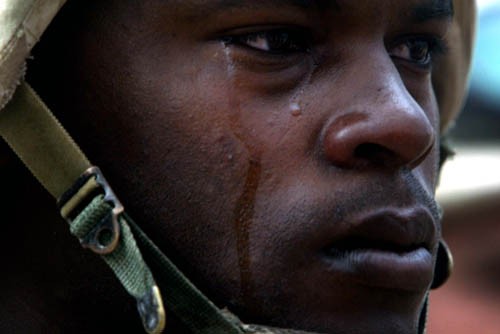
The Pains Of War

Nigeria Cedes Bakassi To Cameroun

2008/08/14
By Emma Una/ Calabar & Eromosele Ebhomele
The controversial Bakassi Peninsula has been formally handed over to the Republic of Cameroun.
The ceremony took place today, in Calabar, the Cross River State capital. Top government officials from Nigeria, Cameroun, representatives of the United Nations, the diplomatic community, etc. witnessed the ceremony.
The Nigerian delegation was led by the Attorney-General and Minister of Justice, Michael Aondoakaa. In his speech at the historic occasion, Aondoakaa said the handing over was a painful exercise. "We are saddled with the painful task of completing the implementation of the ICJ judgement," he said.
According to him, there are arrangements for the resettlement of those who have chosen to leave the peninsula, promising the Nigerian indigenes who would remain in the area that their fundamental human rights would be maintained.
While the Acting-Governor of Cross River State, R. Hon. Francis Adah, tasked the international community to assist in resettling the displaced Nigerians, who, he said, were already traumatised, the Camerounian minister of State for Justice, Professor Maurice Kamto, confirmed that his country would honour the Green Tree Agreement between the two countries. The United Nations Secretary General, who was represented, promised that the world body will support the displaced people and the governments of the two countries.
The hand over process started two years ago, at exactly noon on Monday, 14 August, 2006, when the Nigerian flag and that of the Nigerian Army were lowered at one of the islands, Archibong Town in Bakassi. They were handed over to the then Attorney-General of the Federation, Chief Bayo Ojo, and the former Chief of Defence Staff, General Martin Luther Agwai, while the Camerounian flag was hoisted. It was then the Bakassi people were first hit by the realisation of a possible hand over of their land to Caremoun. They had thought a miracle would happen to change the International Court of Justice's ruling in favour of Cameroun.
This ceremony became the first phase of the final hand over of the Peninsula extension of the territory of Calabar into the Atlantic Ocean with a population of between 250,000 to 300,000 people. The Republic of Cameroun had continually emphasised that the land belongs to it, capitalising on two agreements reached between it and the Nigerian government in the 1970s. The Yaounde II Declaration of 4 April, 1971, and the Maroua Declaration of 1 June, 1975, were devised to outline maritime boundaries between the two countries following their independence.
The line was reportedly drawn through the Cross River estuary to the West of the Peninsula, thereby implying Camerounian ownership over Bakassi which covers an area of 665sq kilometers. Nigeria never ratified the agreement and Cameroun regarded it as being in force and this prompted the ICJ ruling in the Hague on 10 October, 2002.
Despite the Green Tree Agreement between former President Olusegun Obasanjo and the Camerounian President, Mr. Paul Biya and the subsequent handing over process, a Federal High court sitting in Abuja put a hold to today's ceremony.
However, for the first time, citizens of the country think that President Musa Yar'Adua has gone against the rule of law. Even members of the House of Representatives think so.
The Chairman of the House Committee on Media and Information, Eziuche Ubani, said the National Assembly should have held on to the alibi of the Federal High Court, Abuja and remind the President of his beleif in the rule of laws.
"We didn't do our job at the National Assembly. There were things we could have done to stop the President from handing over our territory, at least for now," he said.
For the Senator representing Bakassi, Senator Bassey Ewah Henshaw, crying would not be enough to show the grief of the people. "Government has scathered my people all over the place. My people are all refugees everywhere with nowhere to call home," he said.
Noting that nothing has come out of the resettlement effort of the Federal government, the Senator said, "the people are very bitter against those people that have done them in. In time, the people will be able to identify the real people who have put them in this terrible condition."
According to him, the National Assembly was yet to ratify the ICJ judgement and the various agreements by the two countries.
Meanwhile, Dr. Ambrose Akpnika, a one time Commissioner for Health in Cross River State and the Mkpisong Ukara of Calabar, has described the proposed relocation of the Bakassi people to Ikang in Akpabuyo Local Government of Cross River State as a farce which is bound to fail.
Dr. Akpanika, who is a prominent indigene of Bakassi, said the people of Bakassi have lived in their present place of abode for over 200 years and have taken the Bakassi Island as their ancestral home, so it would be difficult to go where they don't know.
Akpanika, who is one of the Kingmakers in Efik Kingdom, said that for a people who have never known any other place as their home, they will resist any attempt made to move them in the name of relocation.
Speaking to P. M. NEWS in Calabar, Dr. Akpaniko said: "my stand on the issue is that there are Bakassi natives and there are also Bakassi people. People from all parts of Nigeria and from other countries who have lived in Bakassi for over 200 years, are called Bakassi people, they have no other home. Now you cannot ask these people to re-locate. But you cannot relocate Bakassi natives who are like the Aborigines Christopher Columbus saw when he went to America .
"But I think there is a contraption trying to remove the Bakassi people from Bakassi. Cameroon was given sovereignty over the land of the people of Bakassi.
"The question of moving them does not arise and the United Nations Charter did not stipulate that," he declared.
He said the people of Bakassi had made presentation to the Senate Committee earlier in the year asking for a stay in the handover but this has been overruled "and I think that they must have made up their minds already about the people of Bakassi and had given one thing that had never been mentioned by anybody."
Dr. Akpanika said the plan of those who are bent on relocating the people want to exploit the resources of the area.
"That Bakassi is full of manganese not just oil that they are fighting for. Those people might be looking at the Manganese and Manganese is a special metal some of which is used in making planes and space ships.
"So Manganese is more expensive than oil, so the people who are now trying to move the natives of Bakassi from their ancestral home to somewhere else are suspect.
"So what we say is that we trace the history of the people to know those who have linkage with Bakassi for some 200 years, those who have gone to Bakassi to do business and those who don't have homes.
"Above all, please, Bakassi natives cannot be relocated from their home land. We have islands that could be filled up for these people who have always done business in the river to resettle."
He asserted that the Calabar channel should therefore not be handed over just like that. "The Agreement that divides the channel into two for Nigeria to occupy one corner while Cameroon occupies the other corner and after five years Cameroon will take over completely, is wrong," he said.


09 August, 2008

DEFENCE PACTS...BAKASSI

The handing over of the Bakassi peninsula to Cameroon that may take place on the 14th of this month is a sad story especially for the inhabitants who we all know dread the Cameroonian government; Resettling them in an already inhabited community is also a bad choice by the FGN.

Going over the whole story of the Bakassi people and mistakes made by all concerned is just as painful as the wound, however, .the most painful of all is the crying of Nigerians which is summarized by these words from The Chief of Defence Staff, General Owoye Azazi,"……..I want to believe that if anything happens between Nigeria and Cameroon, the defence treaty between France and Cameroon would be called to force. They have such treaty with their former colonies. We don't have defence treaty with any country; we only have training agreements……………………" http://allafrica.com/stories/200807170436.html

In another interview a Nigerian officer bemoaned our stars because our defence agreement with Britain is worthless according to him. Is it not shameful that at this 'age' Nigeria or any African country should cry because she has no OYIBO (Whitman) to rush to help her beat-up her neighbouring African sister? It is a shame.

In the '80s before the sell out of the peninsular by those we know, the Nigerian armed forces (Army, Navy and Air force) did a spectacular military manoeuvre in that area (operation Sea Dog) probably to send a massage to Cameroon or to show 'we can be pugnacious at times if you step on my toes'. I lived in Enugu then, and we were all proud of the military movements/shipments toward Calabar area , but also wished those 'idle soldiers' did some other important social work for the community instead of going to play war games, eating fish pepper-soup and beer in Calabar creeks.

France did not waste a day in sending a matching force to Cameroon. Mirage jets started flying over the air spaces of Cameroon and we learnt even provoking the Nigerian military manoeuvres inside Nigeria spaces. The planes were taking off from an Aircraft carrier because the never cared to build any airport fit for such crafts for their ex-colonies and friends.

Now Nigeria is mourning because France wont allow her beat up Cameron and Britain may not come to our side to assist us because we do not have an 'all inclusive' defence pact with the Queen.

On the other hand Cameroon is happy because 'now our master is at the corner waiting for those big fools from Nigeria to cough loud in our direction….. after all said and done through them and their (ELF) oil company , the petroleum in Bakassi will soon make us better than Nigeria- that prodigal son of Africa"

These deep-rooted colonial mentality at his century is the most worrying aspect of this Bakassi issue.

Why must we at this age allow the colonial wolves come back to show us our boundaries. Is it of whose interest that these boundaries are shifted right or left?

It is a shame ladies and gentlemen.

Africa must wake up! It is not yet late.
Chukwubike .O Charles
( Cultural Mediator)
Foundation for Peace culture & Social Development (fpsd)

07 August, 2008

Why Nigeria Lost Bakassi At The World Court -Wali


Alhaji Aminu Wali was Nigeria's permanent Representative to the United Nations. The Kano politician was at the UN when the controversial verdict ceding the Bakassi peninsular to Cameroon was reached at the International Court of Justice at The Hague.

He spoke with Augustine Madu West on the August 14 handover of Bakassi to Cameroon, the country's mistake on the case and the disturbing development in the Niger-Delta region. Excerpts:
What are Nigeria's chances of securing a permanent seat in the United Nations?
---------------------------------------------------------------------------------------------
You are aware that there are 192 member states in the UN, and there are only five permanent seats. As it is now, we have five regions in the world as enumerated by the United Nations. There is the African region, Asia, Europe, America and every single region has representation on the Security Council except Africa. That is what we have been saying collectively as Africa, up to the time I took my exit from the UN. A panel set up by the former UN Secretary-General, Koffi Annan, recommended two options - Option A and Option B - for the reform of the Security Council. We in Africa opted for Option A, which means we want permanent seats, additional permanent seats. The recommendation was that Africa should have two permanent seats. Is not something that would happen in the next five years, I am not very sure? For now, the ball is basically in Africa's court. The biggest problem that Nigeria has to emerge as one of those countries that is endorsed by Africa to seat on one of the two seats... I have personally fought for Nigeria to be accepted by our own region as one of those two. It should be noted that there are three major competitors, namely: Nigeria, Egypt and South Africa. These are the serious contenders for the permanent seats. I do believe my successor, Prof. Joy Ogwu will definitely continue from where I stopped, and I do believe that she is adequately well-armed to continue with that struggle. Let me, however, point out that, it is not going to be easy. For various reasons the permanent members that are on the Security Council are not comfortable with the idea of having more permanent members. Any permanent member, for example, emerging economies, India has nuclear power; it is one of those economies that will soon overtake Western Europe. They are vying for a permanent seat. There is Japan, which is supposed to be the second largest economy and their contribution to the UN activities is only second to the United States, yet they are not permanent members; but they are now vying for a permanent seat which, of course, America is supporting. For example, China is not happy having Japan coming in as a permanent member. Also, the Security Council will also have to pass a resolution which has to be adopted by all the five permanent members. But if one of the five permanent members decides not to accept it, then the whole issue will be scuttled. And even if they did, two-third of all member-states, including all the five permanent members, will have to ratify it in their National Assemblies and Congresses before it takes effect. So, you see, it is not an easy thing to say we want a permanent seat, it is not something that will happen in the immediate future. You can get through the whole process in New York, but then the National Assemblies and Congresses of member-states would have to ratify it before it takes effect. For example, the U.S. Congress can decide not to ratify, the Chinese People's Assembly may say they may not ratify it or the British, the Russians or the French.[Cuts in]
Has Nigeria played enough politics in this regard for securing a permanent seat?
------------------------------------------------------------------------------------------
Well, you see, it is a bit complicated for us in Africa. The initial problem that we would have in New York is for us to first of all solve our problems in our region, that is Africa. There are a lot of spoilers, those that are pushed by external forces to get into the fray so that they can confuse issues in Africa. I can assure you that we have expressed interest in the seat, so has countries like South Africa, Egypt, Senegal, Syria and Comoros Island. Angola is on the fence and they will soon express interest for a permanent seat. We have to contend with all these. But we must first of all sit down in Africa to harmonise our interest, because there is no way you will have two-third in the General Assembly with Africa Bloc. And normally, Africa will always vote as one bloc. For example, there is no way I, as Nigeria's Ambassador will accept or allow or concede to any other country because for me if a permanent seat should be given to Africa, it should be Nigeria. Nigeria represents the largest Black Nation in Africa. Every four black man in the world is a Nigerian. The problem is created by recommending two seats for Africa. If it were one, there would have been no problem because every one know that Nigeria should have that. Libya is also interested. It is a bit complicated, but our problem is within our region.
In this situation, what do we do?
-----------------------------------------------------------------------------------------
We should attempt to convince, lobby and be diplomatic in our approach. The style and way of handling issues by President Yar'Adua will help because his style does not alienate. He is very humble and is not scared of his colleagues. So his attitude and demeanor will probably help us a lot in achieving our goals.
During your tenure, how much of this lobby took place?
---------------------------------------------------------------------------
A lot of lobbing took place during my tenure, but I assure you that as we lobbied, so also was Egypt, South Africa, Senegal and Libya. There are does that knew they could not possibly get it, therefore, they don't want Option A (permanent seat). They want additional non-permanent seat which will be rotational. That is very disadvantageous and does not give room for effectiveness in the Supreme Council. Having a permanent seat gives one an age over and above every body in the system. That's why those that are opposite to it will argue that they do not want to create another aristocracy, because those permanent are the aristocrats of the UN - they can more or less bring to a stand still any activity of the UN at any given time.
Are you saying that Yar'Adua's style of leadership will play a major role in Nigeria's quest to secure permanent seat in the UN?
---------------------------------------------------------------------------------------
Yar'Adua's approach and demeanor, as well as his disposition will make a lot of his colleagues feel at ease. Maybe, to be able to concede or to accept to go along with Nigeria having a permanent seat.
----------------------------------------------------------------------
What is your reaction to what happened in Zimbabwe which is now happening in Sudan whose president has been ordered to appear before the prosecutor of the International Court?
-----------------------------------------------------------------------
As far as I am concerned, I am in total opposition to the prosecutor of the International Court. Because, one, we know how much efforts we have been putting in to strike a peace deal in Sudan. There is no way you can stop the killing and raping in that part of the world unless you have the co-operation of the government of Sudan. When you said you have indicted the President of Sudan, and that you will prosecute him, then whom are you going to talk with? Because, that court is more of a court that is set up by the United Nations. Now, if the UN is to operate in Sudan as a peacemaker, then they should not be seen as partisan. To undermine the authority or to say that the man who is the president of that country is a wanted person. So, how can you now say he is a criminal, and you keep on talking with that criminal, you can not eat your cake and have it. Whatever they have against the President of Sudan, as things are today, there is no way we can have peace without the co-operation of the government of Sudan headed by Muhammad El Bashir.
Do you share the view that to have him prosecuted will escalate the crisis in Sudan?
Absolutely! But thank God the Africa Union has already disassociated itself from the prosecutor. They have already issued a statement saying that it was wrong and they are not in support of what the prosecutor or court has done. I am certainly totally in agreement with the African Union in that regard.
In your opinion, has the AU done enough in resolving the conflicts engulfing African Nations?
People view this problem as an easy thing, like having a dispute in one's community which can be sorted out with ease, no. Once you are dealing with national problem, each member of AU is a sovereign state and each member has a right to refuse; you cannot override their decision. Every president that attends the meeting goes there as the head of the sovereign nation, not subservient to any other person or any other body, because no country is prepared to sacrifice its sovereignty for the sake of any other nation. So, if you look at it from that context, then you have to understand how that body works. It is only a question of consensus; and there must be a spirit of give and take, and sometimes you have to jettison principles for all things to work in diplomacy. It is not proper to say that the AU is not doing what they are supposed to be doing; it is doing its best under those circumstances.
It is believed that the issue of not interfering with a sovereign nation's internal affairs stopped AU from intervening in what is happening in Zimbabwe. Is that enough reason ?
Yes, you can say that because it is Zimbabwe, but tomorrow it could be Nigeria. You will be the first person to cry out - why is AU interfering in other country's internal Affairs?
Cuts.....In other words, you are interested in what is happening with Changarai, which is about accepting Robert Mugabe?
Well, my brother you are sitting here in Nigeria while Mugabe and Changarai are sitting there in Zimbabwe; their problem they understand better than you and I.
You were once Nigeria's representative in the UN. How was it like being there?
I will say that I am proud and honoured to serve my country as a representative of the body because it helped me to learn and understand issues which otherwise I would never have dreamt of understanding; and to serve in the UN is to serve in the World Parliament if you like. This is where every country is being represented, and what is happening there is a serious business of making sure that the human race is being served properly, and all efforts being made to safeguard the future of the human race. The work that is being done by the UN is unquantifiable, except, of course, since its function is abstract. Sometimes, people don't see, for example, even peacekeeping worldwide. Today, the budget of the UN for the peacekeeping is about two or three times the budget of running the UN. And when you look at the other services being provided by the UN, it's only when you have time to go through its documents that you will realise that there is no organisation in this world that is doing much as the UN is doing for humanity. If you look at the Human Right and Peace Building Commission as well as Peacekeeping Operations, and the Millennium Development Goals (MDGs). So, when you look at this major issues involving every human being on earth like environmental pollution, you will know that the UN is one body that we cannot afford to ignore, and every human being should embrace the UN because that is the only continental body which we have that is trying to bring everybody together for the common good of mankind.
Nigeria is going to surrender Bakassi in the next few weeks (August 14). A lot of people are opposed to it, and they are disenchanted. What is your reaction because you were on seat at the UN when the World Court passed the verdict?
You have to go back to the historical background of Bakassi. The boundaries were demarcated before we were all born, during the colonial era. And when the crisis erupted, we decided to go to the International Court of Justice at The Hague. And before a decision was made, Nigeria and Cameroon agreed and accepted that they will abide by the decision of the court. We submitted that we will abide by whatever decision they will come out with. When the decision finally came, we lost Bakassi. That is why Bakassi is taking the front burner. But when you go through the demarcation of the border from Chad, all the way down to the Atlantic Ocean, when you look at the map on the balance, you will see that Nigeria gained more land than Cameroon, simply because Bakassi happened to be thrown on that side, that is why it is taking the front seat. But as far as I am concerned, when you talk about the Rule of Law, and when you talked about International Law, we willingly submitted ourselves that we will accept the verdict. I don't think that there is much we can do because we have to be honourable in our own action.
Do you believe that the politics of Bakassi was played outside the court?
I was Nigeria's Representative at the UN. I only deal with what is document to me. I don't know. But I doubt if that allegation is true because you are dealing with an issue at the highest court, that is the International Court of Justice at The Hague. Of course, most of these decisions tend to have some political elements. For example, in the Supreme Court in Nigeria, or in any other country, a lot of decisions do reflect the political situations. But for that particular issue of Bakassi, they got technical experts and experts who screened documents which took a lot longer time than envisaged before a decision was taken.
But what some constitutional lawyers are saying is that Nigeria has 774 local government areas, and for us to excise one, the Constitution has to be amended.
Yes, I understand that but we agreed to abide by the decision of the court, as a country. Now, once a decision is made, if a mistake was made, which I can see in one area that is, Nigeria Government should have referred the issue to the states and National Assembly before a final decision was taken. But I know that when the decision was taken and when the Green Tree Agreement was signed, this was immediatelly forwarded to the National Assembly. If there was a mistake, it is a question of procedure, not question of law. We accepted to abide by the verdict. What should have been done is once verdict was given, then we should have settled down to look at the procedure and how we should go about it.
But we could have rejected the verdict because it was alleged that the ICJ's verdict is advisory and not compulsory?
That was why we were asked even before the judgment was delivered, that if we will subject ourselves to be bound by the decision, and we said yes. And at that time no body had the premonition of what the outcome would be.
From what you are saying, there is nothing much Nigeria can do about the Bakassi peninsular?
Well, I am not a lawyer.
How did Nigeria fair in the UN during your tenure. What would you describe as the major challenge or challenges?
One of my major challenges was the creation of the Human Rights Commission, which was done while I was there. I led Nigeria's negotiation and discussion in the office of the council, the new Human Rights Council and also the Peace Building Commission, which is a new body that will help those countries emerging from conflicts to build peace, like what is going on in Sierra Leone and Burundi. Before I left, these two countries were being taken in by the Peace Building Commission. We were able to conclude and establish the Human Right Council and the Peace Building Commission. These were the high points of my tenure, and Nigeria was involved in it and we were elected members of the Human Rights Commission as well as the Peace Building Commission.
What aspect of your stay in the UN do you regret?
None. I have no regrets because the nature of events in the UN do not happen in 10 years or there about. I cannot regret because whatever I did, I put in my best and we did our best under those circumstances, and we were able to achieve a lot and maintained the respect Nigeria enjoys today within the world community. And certainly, by the time I came back, we have earned our country the respect of the international community.
Can you briefly tell us what Nigeria's situation was before you got to the UN?
It was very good, because by that time we have gone back to democracy and the whole world welcomed us and, obviously, we went on to build on that initial goodwill. Thank God, Chief Louis Mbanefo went there and did his own bit. I only went there to improve on his performance and achievement. And I believe that Prof. Ogwu will also continue with the same goodwill.
What will be your advice to her?
I don't have much to advise her because she is vast in that field even before she got there. She has been in the system for a very long time, having worked at the Institute of International Affairs and ended as the Director-General of the Institute. She has also been working with the UN over a period of time, and she had been Nigeria's Foreign Affairs Minister. The bottom- line is that, she is better equipped than I was and she understands the issues better than I did before I went to the UN. I have absolute confidence in her ability to take Nigeria to the next level at the UN.
What is your feeling about the development in the Niger-Delta?
As a diplomat, I am not prepared to say much on these issues. I know the Human Rights Council is there in Geneva, and if there is any problem that any body feels that the Human Rights Council should look at, I am sure the Niger Delta are in touch with the Council, if at all their Human Rights are being violated.
What is the way forward regarding the Niger-Delta problem?
The way forward is what the government has been doing: dialogue, political solution and also containing the criminal elements within the region.


Posta, news, sport, oroscopo: tutto in una sola pagina
Crea l'home page che piace a te!.


Posta, news, sport, oroscopo: tutto in una sola pagina
Crea l'home page che piace a te!.

29 July, 2008

Nigerian Army General becomes UN peacekeeping adviser

New York, UN - Nigeria's Lt.-Gen. Chikadibia Obiakor, the newly-appointed peacekeeping adviser to the UN Secretary-General Ban Ki-moon assumed duty at the UN headquarters here, PANA reported Sunday.He is the first military adviser at the world body and will hold the position of Assistant Secretary-General."Obiakor, 57, will advise on military affairs for the 110,000-strong UN peacekee ping force following a 35-year career in the Nigerian armed forces, where he earned the rank of three-star general,''a UN statement said at the weekend.It stated that he served as the top commander for the UN Mission in Liberia (UNMIL) and the artillery brigade for the Economic Community of West African States (ECOWAS) Monitoring Group, where he coordinated border patrols in the region.The statement quoted General Obiakor as saying that his command strategy included prompt action and strict discipline in mitigating conflicts."I believe in the deterrence value, because if you don't deal with the matter, the tendency is that somebody else will attempt it," it quoted Obiakor as saying.The Nigerian general had also presided over the deployment of the first UN all-f emale police force in Liberia while serving at UNMIL.Obiakor began his career with the Nigerian Army in 1973, rising up the ranks to become a three-star general in December 2005.The uniformed personnel that serve in UN peacekeeping operations hail from 119 different countries, an all-time record.Nigeria is the fourth largest contributor of military and police personnel to UN peacekeeping operations around the world. New York - 28/07/2008