Showing posts with label CHUKBYKE. Show all posts

17 September, 2018

ELECTRIC TRICYCLE MADE IN ABA HITS THE ROADS THIS MONTH

Update: More Details about Nigerian Made Keke Napep

The people in Aba are well known for their business expertise and their ability to manufacture local products, and they have lived up to expectation with their latest invention
Ifeanyi Okafor, who hails from Umuchu, Anambra State, successfully manufactured the tricycle.
A graduate of the University of Nigeria, Nsukka, Ifeanyi Okafor explains that the project began in 2015, during the fuel scarcity that hit the country in May/June. Angered by a system which he explains, “holds the people to ransom”, he started researching and designing the prototype which would run on electricity rather than fuel. Okafor leases keke napeps to drivers who he said complained often about a lack of fuel impeding business. These propelled Okafor on a search for an alternative means of powering the keke napeps.


According to a report from AutoSage, the name of the manufacturer who hails from Anambra state is Ifeanyi Nnamdi Okafor.
Update: More Details about Nigerian Made Keke Napep
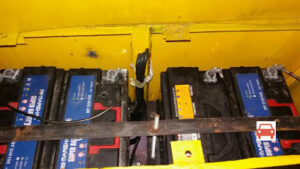
Ifeanyi was able to construct and manufacture this Keke Napep by sourcing the materials locally.
Part of the material used include batteries, local welding materials, steels among others.
Update: More Details about Nigerian Made Keke Napep

Reports gathered have it that Ifeanyi was also planning to execute electric bike, the bike will be powered using only batteries. Mr. Ifeanyi was said to have called an electrician, welder, painter who helped to put his ideas into reality…
Update: More Details about Nigerian Made Keke Napep
The tricycle is said to run at 50km/ph which is the speed limit for now; to avoid accidents on the road. Compared to the petrol-powered Keke of 56km/ph.
According to Mr. Okafor, the safety of the driver and the passenger is of utmost importance to him. He also said that he plans to take advantage of safety technology to protect the Keke from theft.
“An app will be made in order to register each tricycle, which will enable it be tracked in case of theft,” he said.
“For now, there is no commercialization,” he said. “But on 27th August, 2018, I will publicly announce how much it will be for sale and how it works too and how it’s being maintained.”

03 October, 2017

Oct 1 speech: Ohanaeze, Ezeife, others blast Buhari

By Emeka Mamah, Ben Agande, Dapo Akinrefon, Simon Ebegbulem, Gbenga Oke, AbdulSalam Muhammad, Peter Okutu & Dirisu Yakubu 


Say he’s trying to push S-East out of Nigeria; full of excuses 
•Speech disappointing, empty —Ozekhome, Junaid Mohammed 
•He has opportunity to bring Nigeria back on track—Afenifere 
•He was rationalising failure
Osuntokun; 

  • it’s laudable— ACF, Oshiomhole


LAGOS – President Muhammadu Buhari’s Independence Day broadcast elicited strong reactions from across the country, yesterday, with Ohanaeze Ndigbo and the Eastern Consultative Assembly, ECA, taking strong exceptions to the indictment of Igbo leaders over the escalation of agitation for Biafra. 
The President’s speech was, however, welcomed by the Arewa Consultative Forum, ACF, and some of the President’s political supporters, including Comrade Adams Oshiomhole.
 However, critics from across the country, including Dr. Junaid Mohammed, Alhaji Tanko Yakassai, Senator Roland Owie, Chief Mike Ozekhome, SAN; Mr. Akin Osuntokun, among others, flayed the speech for either being empty, sectional or lacking in imagination. 

The Peoples Democratic Party, PDP, which was the object of criticism in the broadcast for allegedly superintending over what the President described as the years of the locust between 1999 and 2015, failed to articulate a reaction yesterday.

Warning against the sustenance of ethnic agitations, Buhari had in the broadcast said: “As a young army officer, I took part from the beginning to the end in our tragic civil war costing about 2m lives, resulting in fearful destruction and untold suffering. Those who are agitating for a re-run were not born by 1967 and have no idea of the horrendous consequences of the civil conflict which we went through,” he said.

Chiding leaders of the region involved, the President said: “I am very disappointed that responsible leaders of these communities do not warn their hot-headed youths what the country went through. Those who were there should tell those who were not there, the consequences of such folly.

” Buhari’s govt always has excuses — Ohanaeze 

Responding to the broadcast, Ohanaeze, responding through its National Publicity Secretary, Prince Uche Achi Okpaga, who described Buhari’s policies as sentimental, lopsided and sectional, advised the APC-led Federal Government to always take responsibility for the current situation in the country.

Ohanaeze Ndigbo said:  “The issue is that the Buhari administration has always found one excuse or the other for the challenges facing the country. They have never taken responsibility before (because) they were not prepared to rule Nigeria. 

“Hate speech started from Buhari and he has continued to implement policies against the existence of Ndigbo. The agitations did not come from oblivion; it is part of his policies which I describe as sentimental and lopsided. These policies had over time fuelled agitations and so, he should not blame Igbo leaders but his administration.

“We blame the agitation on his administration and not Igbo leaders.” ECA, in a statement said it was a regret that the President, helped by his kitchen cabinet, had continued to see Nigeria on  an ethnic prism.

ECA Secretary, Evangelist Elliot Ugochukwu-Uko, while reacting to the speech said: “Mr. President has finally confirmed to all and sundry that he is light years behind global trends and far away from the political reality of the Nigerian situation. This is exactly what happens when a leader surrounds himself only with his kinsmen.
 “They erroneously mistake their sectional worldview as the national interest. Gen Buhari has clearly misread the resolve of the younger generation to change their lot in Nigeria through any means necessary.
“His kitchen cabinet is obviously living in an ancient world where the fear of the inevitable restructuring forced them to take solace inside the cocoon of an outdated, unrealistic northern daydream of forcing Nigerians to head to a National Assembly which was created by a discredited military constitution. “The obstinacy of those scared of the inevitable new people’s Constitution, regional autonomy, and true fiscal federalism gave birth to the agitation for secession; this same obstinacy will ultimately destroy Nigeria. “As the agitation rebounds and resurges, time will unveil the price we all will pay for delaying the return of Nigeria back to regional format.”

Buhari trying to push S-East out of Nigeria —
Ezeife Former governor of Anambra State, Chief Chukwuemeka Ezeife on his part said President Buhari was trying to push the region out of the Nigerian State. “Buhari is the engineer of the problems. He is trying to push the South-East out of Nigeria by marginalising, dehumanising and humiliating them,” he said, adding that the development led to the agitations by the youths that has now morphed into a national concern. “The young ones couldn’t understand what he was up to and so they reacted as young people. “We didn’t have these problems under President Olusegun Obasanjo,  Umaru Yar’Adua or Goodluck Jonathan but immediately Buhari took the oath of office and swore to protect the Constitution, he reneged on such things as the federal character.

“He told us he belongs to everybody and to nobody but we have seen that he belongs to Katsina,” he added. Buhari’s speech disappointing, says Ozekhome Rights activist and constitutional lawyer, Mike Ozekhome, SAN, flayed the speech as not good enough. 

Describing the speech as “disappointing” Ozekhome noted that President Buhari left the real issues for trivialities, wondering why the Commander-in-Chief failed to say a word on the threats issued against the Igbo by the Arewa youths. He told Vanguard that the President’s perceived hatred for the Igbo, again manifested in his national broadcast, saying his description of the nation under his stewardship is far from reality.

Nothing interesting from Buhari—Junaid Mohammed
 In his reaction, Second Republic lawmaker, Dr. Junaid Mohammed, said the speech lacked substance, adding that there was nothing interesting about it. He said: “I feel very sad that Nigerians have found themselves in this quagmire and it is very unfortunate. “Unfortunately, he surrounded himself with family members who have no experience about government. So what do you expect from such government? “I strongly believe Buhari cannot take this country to the promised land and for him to be telling us his experience as a junior officer in the military when the country needs urgent attention is unbecoming of a leader.”

He has opportunity to bring Nigeria back on track—Afenifere 
For the pan-Yoruba socio-political organisation, Afenifere, the President has the opportunity to bring Nigeria back on track by restructuring the country. Afenifere’s National Publicity Secretary, Mr. Yinka Odumakin, said: “The only way Nigeria will not disintegrate under him (Buhari) is for him to begin to lead the conversations around the need to restore Nigeria to better federalism as promised in the APC manifesto. “He still has the opportunity to bring Nigeria back on track. The call for restructuring is the call for a better Nigeria, the call for restructuring is to avoid a breakup.

” Nothing new, says Yakasai
 Yakasai on his part, dismissed the speech as empty on the claim that the President did not say anything new. “From my own understanding, President Buhari did not say anything new, and there is nothing new about the speech most especially if you are conversant with his style,’’ he said.

 He was rationalising failure —Osuntokun 
Mr. Akin Osuntokun, who served as Political Adviser in the Olusegun Obasanjo administration, said there was nothing remarkable about President Buhari’s broadcast. He said: “First I am happy for the President that he looks well-rested and apparently in good health. There is nothing particularly remarkable, negative or positive about the speech. “It was all about exaggerating modest achievements and rationalizing failure. You can see the escapist argument he was making on the seeming intractability of the Boko Haram insurgency.” 

No hope in the speech — Owie 
Former Senate Chief Whip, Senator Roland Owie, also faulted the speech saying: “I see no hope in that speech. It is unfortunate that Nigeria has found itself in this situation under a government that has no direction. The anniversary speech does not give hope to anybody. “He was elected to preside over the country, but he is not doing that. When I compare what happened in 1983 when he came first and when he came now, nothing has changed.

” Buhari’s speech is way to go — ACF 
The ACF, however, welcomed the President’s speech as soothing, saying it was the way to go. The ACF in an email reaction sent to Vanguard through its Publicity Secretary, Muhammadu Ibrahim Biu, said the speech was  “a score card of the Buhari administration on securing, economy and corruption which was the hallmark of his campaign promises. “ACF advocates peaceful and meaningful dialogue on all issues of national importance and the use of our democratic institutions to achieve better results. Agitations that come with threats and intimidation have no place in our present democratic dispensation. ACF would, therefore, support any restructuring that comes with clarity of purpose and is just, fair and equitable to all sections of the country,” he said. 

Buhari deserves applause — Oshiomhole
Former Edo State governor, Adams Oshiomhole, while also praising the President’s speech said:  “I think the President’s speech made it clear about what is being expected and the progress made so far. The president has emphasized that the unity of this nation is non-negotiable and that is the stand of most of us. “That is sending a message to all those who are plotting one evil or the other against this nation. The President also emphasized plans to create more employment for our youths to check restiveness. So I see hope because if you look at where we are coming from you will know that we are on the right track with President Buhari as President. He deserves applause for this” he stated.

Read more at: https://www.vanguardngr.com/2017/10/oct-1-speech-ohanaeze-ezeife-others-blast-buhari/


29 March, 2016

The man, Tunji Braithwaite


The man, Tunji Braithwaite

By Cosmas Omegoh and Ndubuisi Orji 
“ALL the world’s a stage, And all the men and women merely players; They have their exits and their entrances, And one man in his time plays many parts,…” says Williams Shakespeare in one of his writing.
For social critic, Tunji Braithwaite, it was time to exit the stage, as he passed on after 82 eventful years, yesterday, while Christians worldwide were celebrating the resurrection of Jesus Christ.
His death effectively drew the curtain on his many years of political and social activism.
A man of many parts – lawyer, activist and politician – he would be remembered as a man who was never afraid to say his mind at any given time and on any issue.
Although, he had a very successful legal career, Braithwaite’s foray into politics did not produce the desired result for him.
Born in 1933, he was educated at the CMS Grammar School between 1946 and 1953, sat for his ‘A’ Levels at the London University at Kennington College in 1955, enrolled as Law student at the Council of Legal Education, London in 1957, graduated as a barrister in 1960 and was called to the Bar at Lincoln’s Inn in February 1961. Thereafter, he signed the Rolls of Barristers at the High Court of Justice, Strand, London before returning to Nigeria, where he was enrolled as a Barrister and Advocate of the Supreme Court of Nigeria in March 1961.
A fearless and controversial lawyer, Braithwaite in 1962 at barely 27, was one of the legal team that defended former premier of Western Region, the late Obafemi Awolowo in the celebrated treasonable felony case brought against him by the Federal Government. He also represented the late Afrobeat icon Fela Anikulapo-Kuti, and his brother, Beko Kuti in the famous unknown soldier saga in 1977. In the case to seek redress against the military regime of General Olusegun Obasanjo, who had detained the duo, Braithwaite fought through the High Court to the Supreme Court.
His politics  
Braithwaite joined politics in 1978 with the launch of his party, the Nigeria Advance Party (NAP) on October 7, 1978. In December 1978, three political pressure groups joined the party. However, the party was denied registration by the electoral commission based on insufficient grassroots support, an action he termed “ neo-colonialist nonsense,” because to him, “ you don’t need permission from any government to form association, to canvass for political positions, so that was where our disagreement started from.”
NAP was eventually registered prior to the 1983 general election and was one of the six political parties that participated in the presidential election that year. The campaign slogan of NAP in the 1983 presidential election was a promise to rid Nigeria of rodents, rats, mosquitoes and cockroaches, euphemism for corruption. The party ceased to exist after the military junta of Major General Muhammadu Buhari took over power in 1983, few months after the election.
However, the party came back to life in the present political dispensation, following the mass registration of political parties, after late Gani Fawehinmi floored the Independent National Electoral Commission (INEC) in court over the non-registration of his party, the National Conscience Party (NCP).
Braithwaite was a member of the 2014 National Conference convened by former President Goodluck Jonathan to fashion out solutions to some of the problems confronting the nation. Until his death, he was in the vanguard for the implementation of the report of that conference.
 http://sunnewsonline.com/the-man-tunji-braithwaite/

26 March, 2016

Enugu community decries arrest of 76 villagers after feud with Fulani herdsmen

Enugu community decries arrest of 76 villagers after feud with Fulani herdsmen


Calls on govt to save their farms 

By Anayo Okoli 
THERE was tension and fear among the residents of Ugwuneshi autonomous community in Awgu Local Government Area of Enugu State, following the alleged arrest of 76 of their people by “men in military uniform” over a clash with Fulani herdsmen. Awgu where the community is situated is a border community with Lokpanta in Umunneochi Local Government Area of Abia State which hosts a cattle market. According to the traditional ruler of the community, Igwe Godwin Nwobi, the incident took place on Thursday last week. Igwe Nwobi alleged that Fulani herdsmen who settled in the community without permission had been using their cattle to destroy their crops and farmlands over the years. He said pleas and warnings from the farmers to the herdsmen had always fallen on deaf ears as they continued to graze on the community’s farmlands with impunity. Irked by the continued destruction of their crops which he said were their only means of livelihood, the youths of community protested the impunity of the herdsmen. He disclosed that after the protest, information filtered in the village that two women who went to farm had been abducted by the herdsmen. “When we got such information, the community gathered to discuss modality of dispatching some people on rescue mission and suddenly they were surrounded by men in military uniform who arrested 76 of them and carried them away in trucks”, the monarch said. He therefore appealed for the intervention of the Enugu State Government, to secure the release of the arrested villagers who he said were taken to Umuahia Prison. “It is wrong for our people who fled the North because of Boko Haram to be treated as slaves in their own land. We don’t want to be destroyed by herdsmen like they did in Agatu, Benue State. Government should please come to our rescue. We appeal to our Governor, and other South East Governors to save Igbo land from herdsmen invasion before it is too late”, Igwe Nwobi lamented. But the Public Relations Officer of the 14 Brigade Ohafia, Major Sydney Mbaneme, denied knowledge of the incident, saying the “men in military uniform” were not soldiers. According to him, they might be fake soldiers and civilians who camouflage themselves, saying that “if at all they are solders, they are not our soldiers.” However, the zonal Police Public Relations Officer of Zone 9, Police Command, Emma Jiakponna, DSP, said he was not aware of the incident.” Meanwhile, Ohanaeze Youth Council has condemned the arrest and detention of the villagers, saying it as “an insult to the Igbo nation.”
Read more at: http://www.vanguardngr.com/2016/03/enugu-community-decries-arrest-76-villagers-feud-fulani-herdsmen/

11 May, 2014

Nigeria schoolgirl abductions: Five questions


Mothers of the missing Chibok schoolgirls abducted by Boko Haram Islamists gather to receive information from officials on 5 May 2014


As international experts arrive in Nigeria to help in the hunt for more than 200 schoolgirls abducted three weeks ago by Islamist militant group Boko Haram, Nigeria analyst Andrew Walker answers five questions about the case:
line break
1: Where are the girls?
The abducted girls from the town of Chibok are thought to be held in the Sambisa forest, a remote and inaccessible area of country.
Nigerian soldiers patrol in the north of Borno state close to a Islamist extremist group Boko Haram former camp on 5 June 2013 near Maidugurimap
It has been reported that the forest is dense and impenetrable, but this is misleading.
The landscape at this latitude south of the Sahara is mostly grassland and scrub woods, with thickly wooded river gullies.
Ridges of granite stick through sandy soil in parts, making it impassable even by four-wheel drive vehicles.
There have been reports that the girls have been taken out of the country, perhaps into northern Cameroon, but this has not been confirmed.
line break
2: Who are the girls?
While the number of girls kidnapped has not been finally settled, the identities of some 180 were released by a Christian activist. These names have not been confirmed. Fifty-three have managed to escape.
In this photo taken Monday 21 April 2014, four female students of the secondary girls' school in Chibok, who were abducted by gunmen and manged to escape, are reunited with their families walk in Chibok, Nigeria
Southern Borno state is home to many Christian communities and it is thought the majority of the girls who have been taken are Christians.
A picture taken from a video distributed to some Nigerian journalists and obtained by AFP on 5 March 2013 showing Boko Haram's leader Abubakar Shekau (C) flanked by six armed and hooded fighters in an undisclosed placeBut there are also Muslim girls among the abducted.
These divisions might not mean much to the people of Chibok, a small community where everyone knows everyone, and families are made up both Christians and Muslims.
line break
3: Why did Boko Haram abduct the girls?
The group condemns those who have been educated in the "Western" system, and is against the education of women.
It has also threatened in the past to kidnap Christian women in retaliation for the arrest of members' wives by the Nigerian security services.
The group's leadership also have a practical reason; insurgents on the move need camp followers and servants.
Women who have escaped in the past have said the group forcibly married captive women to favoured commanders as a reward, or used women as sex slaves for their troops.
line break
4: Why was Nigeria so slow to do anything?
Nigerians have become inured to daily tales of horror that come out of the north and politicians are not exempt from this.
Many people in Nigeria feel a sense of desperate fatalism about the conflict; for days it seemed the kidnapping was just another event in a campaign of violence that rumbles on without a clear solution.

Boko Haram at a glance

  • Founded in 2002
  • Initially focused on opposing Western education - Boko Haram means "Western education is forbidden" in the local Hausa language
  • Launched military operations in 2009 to create Islamic state
  • Thousands killed, mostly in north-eastern Nigeria - also attacked police and UN headquarters in capital, Abuja
  • Some three million people affected
  • Declared terrorist group by US in 2013
The number of girls taken did not initially register, perhaps because in most news stories numbers are unreliable and routinely ignored.
Divisions among the political class in the run-up to next year's elections have also made things difficult.
The north-eastern states where Boko Haram is strongest are run by opposition governors, leading to a lack of trust between the central government and local leaders, and vice versa.
This, people around the government say, led to it distancing itself from the problem for fear of falling into a political trap.
But the government lacks the capacity to act effectively in many areas of governance - in energy policy, education, health, as well as security.
line break
5: Why did Nigeria change its mind on foreign assistance?
Nigeria is very prickly about its sovereignty.
Until now it has rejected requests to base Africom, the US military's African command centre, in the country. It favours funding its own, as yet unsuccessful, unmanned aerial vehicle, or drone, programme.
People attend a demonstration calling on the government to rescue the kidnapped school girls from the Chibok government secondary school, outside the defence headquarters in Abuja, Nigeria, Tuesday 6 May 2014
Under the global spotlight, and with delegations form many nations in the capital, Abuja, for the World Economic Forum for Africa this week, it has relented and allowed in foreign security advisers.
In the past President Goodluck Jonathan has asked for foreign governments to "support the Nigerian government's efforts" against Boko Haram - interpreted as a request for money.
Extra aid was not forthcoming then, but it may be now
 http://www.bbc.com/news/world-africa-27348354


29 March, 2014

JTF arrests 2 Britons, 12 Nigerians for illegal bunker

JTF arrests 2 Britons, 12 Nigerians for illegal bunkering

on    /   in News 12:29 am   /   Comments
…Rejects $66,500 bribe offer
By SAMUEL OYADONGHA, Yenagia
Operatives of the Joint Task Force in the Niger Delta code named Operation Pulo Shield have arrested two Britons and 12 Nigerian technicians over their alleged involvement in illegal bunkering along the Chanomi Creek in the western delta.
The suspects were said to have   offered the operatives of the JTF  the sum of $66,500, to create safe passage for them to siphon crude oil into their barges from a Shell Petroleum Development Company pipeline along the Chanomi creek in Delta State.   But the offer was rejected.
The arrested Britons and Nigerians by the JTF for illegal bunkering
The two Britons identified are Messrs Piers Eastwood and Vincent Haywood attached to a United Kingdom based maritime security firm with regional branch in Lagos, according to the JTF, were to provide security/consultancy to MT Crete, a vessel believed to have positioned at Brass open waters for supposed illegal bunkering.
Trouble, it was learnt, started for the suspects when on March 17, a representative of a firm (name withheld) approached the JTF   Headquarters, with an approval letter from the Nigerian Navy Ship Delta and an authorization from the Nigeria National Petroleum Corporation NNPC through the Naval Headquarters.
The approval, Saturday Vanguard learnt, was to evacuate products from an arrested vessel under the custody of the NN at NNS DELTA between 12 March -14 April 2014.
The Joint Task Force approval was reportedly issued and immediately, the headquarters directed Sector 1 of the special security outfit to monitor their activities in the waterways.
Speaking to newsmen yesterday  at the headquarters of the JTF in Yenagoa where the suspects were paraded, the commander of the outfit, Major General Emmanuel Atewe who was represented by the Media  Coordinator, JMCC Col Onyema   Nwachukwu said they were arrested by operatives of the task force as part of ongoing effort to combat the menace of crude oil theft and other sundry crimes in the region.
According to him, “the Operations officer of 3 Battalion discovered through their confession that their intention was to hack into one of SPDC pipelines in Chanomi creek, Warri Delta State and siphon crude oil.
”They gave him as an initial payment, a bribe of $5,000 for recharge card and $1500 to fuel a gunboat that will escort the stolen crude oil.”
According to him, they requested the Operations Officer of 3 Battalion to facilitate a meeting with the Commander 4 Brigade, Brig Gen Fidelis Azinta.
Continuing he said, “the meeting was convened as a bait on March 20, 2014 at the Brigade Commander’s office. During the meeting, the suspects expressed their desire to connect a hose to SPDC pipeline along the Chanomi creek in Delta State so as to illegally siphon crude oil into barges.
”While in the Brigade Commander’s office, they promised to bribe the Brigade’s Commander, with the sum of N20m as well as take care of the officers and soldiers along the Chanomi creek.
”On 21 March   2014, one of the suspects brought to the Brigade Commander $60,000 which translates to N10m being 50 per cent of the N20m promised. The suspects were immediately arrested for attempting to bribe the Brigade Commander for economic sabotage.
”Twelve technicians who were to connect the hoses to facilitate the theft and their implements were also arrested.”
He added that a follow up operation subsequently led to the arrest of two Britons, who were in company of seven Nigeria policemen led by an inspector.
The two Britons, according to the JTF commander were security consultants from a United Kingdom- based port maritime security firm with regional branch in Lagos.
”The two flew into Lagos on 20 March and left for Port Harcourt same day where they met with a Nigerian (one Bello) who was supposed to be their point of contact. The two Britons were to provide security escort/consultancy to MT Crete, a vessel believed to have been positioned at Brass open waters for suspected illegal oil bunkering”.
Gen Awete revealed that all the suspects and exhibits were transferred to JTF headquarters on March 23 for further investigation adding that a joint investigation team was immediately constituted to carry out a preliminary investigation where all the suspects and witnesses were invited and also examined the exhibits, documents and equipment recovered.
This include, the sixty thousand dollars offered to Brig Gen Azinta, the six thousand five hundred dollars offered to Capt M Abdullahi which were displayed to newsmen.
The suspects were later handed over to the Department of State Security for prosecution.
http://www.vanguardngr.com/2014/03/jtf-arrests-2-britons-12-nigerians-illegal-bunkering/?utm_source=dlvr.it&utm_medium=facebook

- See more at: http://www.vanguardngr.com/2014/03/jtf-arrests-2-britons-12-nigerians-illegal-bunkering/?utm_source=dlvr.it&utm_medium=facebook#sthash.JcfrS1x8.dpuf

25 August, 2013

FEMI FANI KAYODE IS NOT YORUBA.....


Breaking News:FEMI FANI KAYODE IS NOT YORUBA:Haunted By A Nupe Ancestry-Fighting A FoggyYoruba Identity Complex


 Image
FEMI FANI KAYODE- Haunted By A Nupe Ancestry- Fighting A Foggy Yoruba Identity Complex
Dr. N. Tony Nwaezeigwe
Senior Research Fellow
Institute of African Studies,
University of Nigeria,
Nsukka.

Nigeria’s nationality question is neither the creation of the Igbo nor the Yoruba. It is the consequence of Hausa-Fulani’s megalomaniac quest for political power in the nation. Yet the Hausa-Fulani accept the fact that both the Igbo and Yoruba hold the key to their attainment of this divine-right objective only if both groups agree to remain suspicious of the other. It therefore becomes obvious that the solution to this national question can only be attained if both the Igbo and Yoruba realize that their mutual understanding and respectof the other’s perception of Nigeria’s progress would save the nation millions in loss of human and material resources.
First, both the Igbo and Yoruba, seen respectively as mentors to other minority ethnic groups in the South and Middle Belt should see their assumed characteristic rivalry, if at all there is something like that, as healthy to the overall development of the Nigerian nation and, not the vice versa. Second, both groups should be aware that this question of Nigeria’s nationality will always persist so long as the Hausa-Fulani feel that without any one of their own being atthe helms of authority in this country, there will be no peace. Andone fundamental means of achieving this Arabian power mentality is to ensure there is perpetual state of political belligerency between the Igbo and Yoruba.

It is on record that both the Igbo and Yoruba cannot write a complete history of their respective roles in the development of the Nigerian nation without mentioning the other in one positive sense or the other. Apart from the fact that both the Igbo and Yoruba were equal stake-holders in the nation’s Independence struggles, theircontacts long pre-dated the arrival of the British colonial adventurers. The Yoruba were the first to establish effective direct contacts with traditional Igbo society long before European incursions. They had penetrated the Igboland before the Igbo themselves thought of coming to Yorubaland. The evidence to this pre-colonial contact is today found in the existence in Igboland of agroup of ancient Yoruba-speaking Igbo sub-group called Olukunmimade up of Ugbodu, Ukwunzu, Ubulubu and Idumuogo towns in Aniocha Local Government Area of Delta State. Although these people could pass as normal Igbo in their general definition of ethnic identity when outside their communities, but they still maintain their Yoruba identity, speaking Yoruba language as their primary mother-tongue alongside Igbo and bearing mixed Igbo-Yoruba names. Most of these people claim to have migrated from Owo in the present Ondo State many centuries ago. Similarly many Yoruba, mainly of Oshogbo and Ogbomosho origins, Nupe and Igala settlers today constitute a substantial portion of Asaba and Onitsha indigenes. These people had settled among the Igbo long before the coming of the Europeans accessing their present abode through the River Niger. Above all, one cannot deny the positive roles such Yoruba missionaries as Bishops Samuel Ajayi Crowther and James Johnson played in the evangelization of Igboland during the nineteenth century.

Thus effective contact between the Igbo and Yoruba not only began many centuries before the creation of modern Nigerian nation, but was initiated by the Yoruba. Those who today think that Igbo-Yoruba contact only began with European colonialism, or that only the Yoruba had been on the receiving end of inter-ethnic migration may be saying so either out of mere ignorance of the subject of Nigerian history, or sheer mischievous and selfish political motives.One does not need to go into the mythical etymology of the word “Igbo” which in Yoruba means forest, but which was in fact first applied by the immigrant Oduduwa group to the aborigines of the present Spiritual kingdom of Ife, ascribing the term to people living in the forest.
There is no gainsaying the fact that the Igbo have always viewed the Yoruba in a healthy competitive sense and not in the light of a heinous political and economic rival, as such Yoruba political torn-coats of doubtful ancestry as Femi Abdulateef Fani-Kayode tend to insinuate. In the same token, the Yoruba on their part cannot claim that the Igbo presence in their land had been that of a habitual Igbo quest to wrestle their ancestral land from them. Not even the ancestral owners of Lagos State of whom Abdulateef Kayode is not part of, can willingly cast aspersion on their Igbo guests, for the latter have always been their willing partners in the progress of their communities.

The Igbo have never been the problem of native Lagosians but the artificial Lagosians, who come to appropriate their political heritage in the name of Oduduwa. These are the people who control theGovernment of Lagos State today, and turn to use the Igbo as a convenient political scapegoat whenever their devious exploitative machinations against the indigenous Lagosians become obvious.This is mainly because this class of artificial Lagosians has always seen the Igbo as the only veritable fall-back strategy by which means the native Lagosians could gain their internal independence from their co-Oduduwa oppressors.
It is on record that during the First Republic both Lagos and Ibadan, the two most prominent Yoruba cities heavily relied on the Igbo-led NCNC for the actualization their political objectives against the Obafemi Awolowo-led Action Group. Even Chief Victor Fani-Kayode, then the Chief thug to Chief Obafemi Awolowo fell out offavour with his master in 1959 his point of refuge was Dr Nnamdi Azikiwe, who promptly appointed him Leader of Opposition in the Western House of Assembly that same year. Chief Obafemi Awolowo took the same line of seeking Igbo succor when he ordered his followers while in prison to ally with the Igbo-led NCNC to forge a common front against reactionary forces in Nigeria of which Chief Victor Fani-Kayode a.k.a. Fani-Power was one such element. So Chief Femi Abdulateef Fani-Kayode lacks every moral pedigree to speak for the Yoruba nation because his father had been a Yoruba quisling, and above all not a true Yoruba son.

Today one fact is pertinent to anyone who savours in the stream of cyclic history Historyrepeats itself only to those who stubbornly refuse to learn from its lessons. There is no doubt that with the approach of the epic political battle of 2015, many desperate and opportunistic attempts would be made by some political desperados, particularly those whose political garbs are woven in uncertain future to cause the repeat of Nigeria’s sad political history. This is the ship Chief Femi Abdulateef Fani-Kayode finds himelf today. He has been out of power and with it came out of money. He is thus in a mission of survival, albeit in a most fatal approach.
In recent times, Nigerians have unwittingly witnessed the unguarded utterances of such political desperados as Malams Nasir el-Rufai and Nuhu Ribadu, both of whom were shot into unmerited political prominence from obscurity by the sheer political benevolence of President Olusegun Obasanjo. Equally lately, it became the turn of one of the celebrated renegades of the apex Yoruba socio-cultural organization- Afenifere and one-time factional leader of Alliance for democracy (AD), Alhaji Bisi Akande to label the President of his country a kindergathen President, all in the name of finding the means to create a leeway of political conflict.
Any person who therefore lives within the orbit of Nigeria’s stream of political progress would easily catch up with the inert motive of this stream of unguarded provocations against the administration of President Jonathan. The Boko Haram insurgency, far from acting the script of alternative state power, subsequently became a dog-eat-dog political cul-de-sac. Those who had hoped to use the deadly Islamic blood-suckers as a full-back alternative strategy if they eventually lose the presidential election against President Jonathan in 2015 are now at a loss as to what next to do. For it has become obvious that neither are they sure of winning the epic electoral battle nor would Boko Haram survive to play the expected yoman role in 2015. It thus became crystal clear when it became the turn of the most colourless political clown of President Olusegun Obasanjo administration to join this stream of agents provocateurs, most politically discerning people quite knew where Chief FemiAbdulateef Fani-Kayode was coming from and where he was going to.
With a quisling political and subservient pedigree haunted by a jaundiced Nupe ancestry, laced with a foggy Saro-Yoruba identity compex, nothing better should have better been expected from Chief David Oluwafemi adewunmi abdulateef Fani-Kayode, a.k.a. Femi Fani-kayode, than his spineless historical verbosity woven in outright haft-truths and infantile sensationalism. As a professional historian, replying to such musings of a habitual moronic mind would amount to giving Femi Abdulateef Fani-Kayode an unmerited intellectual prominence, which indeed is his hidden motive behind his calculated infamy against the Igbo.

But one question which readily strikes the mind is, does being an alumnus of Cambridge University automatically transform Abdulateef Fani-Kayode into an expert of anything? As a lawyer, if one may be tempted to ask, what intellectual and professional landmarks could Abdulateef Fani-Kayode lay claim to? Is it not on record that this same Abdulateef Fani-Kayode has not been able to run and manage a viable law firm, just as his father, Chief Victor Babaremilekun Adetokunboh Fani-Kayode could not, but relied on the tutelage of the likes of Chief Rotimi Williams and later Justicoe Soweminmo. Thus outside the spoils of political office, Femi Abdulateef Fani-Kayode, like his father Victor, is bound to be a political desperado any he is put out political office. It is only calamitous that he chose the Igbo this time for his habitual vain-glorious attempt to re-launch himself into political relevance.
His attacks on the Igbo as to which people are the bona fide owners of Lagos State is thus as misplaced and misdirected as it is a desperate self-propping political venture for a diminished political carpet-bagger. One fact is pertinent, the Nigeria’s convention one’s origins, Lagos is neither the home of the Igbo nor any Yoruba whose parents migrated from somewhere else outside Yorubaland, whether the person is born there or not. Lagos belongs to a definable ethnic and sub-ethnic groups of people- the Eko of Lagos Island and mainland who could even conveniently claim Bini ancestry, theEgba of Epe and Ikorodu axis, the Egbado of Agege-Ifako-Ijaiye axis the Egun of Badagry axis, and the Awori of western axis. It thus follows that any Yoruba cannot fall within any of these categories of native Lagosians is as good a stranger as any Igbo resident in Lagos, just as any non-Onitsha Igbo resident in Onitsha cannot claim any better right over a Yoruba resident there.

Chief David Oluwafemi Adewunmi Abdulateef Fani-Kayode is the least of any Yorubaman to cast any form of aspersion on Igbo contributions to the development of Lagos State, for he is not of original Yoruba protegy. He cannot identify his line of ancestry beyond his great-grand father Reverand Emmanuel Adedapo kayodes, a Nupe Sierra Leonean captive of the British Anti-Slavery squad from a Portuguese Slave merchant vessel of the coast of Dahomey. Reverend Emmanuel Kayode was eventually adopted as a house-boy by Bishop Samuel Ajayi Crowther who gave him Yoruba names and subsequently trained him up to Fourah Bay College, Freetown and enlisted him as an Anglican Priest. Reverend kayode, in line with the tradition of the Saro-Yoruba of the time, subsequently adopted Ife as his ancestral home in a bid to historically confirm his new Yoruba identity.
But his father Chief Victor Babaremilekun Adetokunboh Fani-Kayode, fully aware of the artificiality of his Yoruba identity later identified the Nupe town of Pategi in the present Niger State as his Grand-father’s ancestral home after he had disrespectfully confronted Chief Obafemi Awolowo in Public and the latter had politely reminded him of his Nupe ancestry. It was in reaction to this obvious revelation by Chief Obafemi Awolowo that he resorted to naming his children after some prominent members of his Nupe family, hence “Abdulateef”, a purely Muslim name was given to his son Femi. The same tradition of Muslim name was applied to Femi’s elder brother who died a number of years ago. It this fact is not on the line of history, let Chief Femi Kayode explain to Nigerians the source of his Muslim name when he claims a pedigree of traditional Christian family, especially when even his mother had strong Christian family background.

In fact again in 1959, during one of his father’s infamous public altercations with Chief Obafemi Awolowo, he was again reminded by the respected sage of his Nupe ancestry. It was when he could no longer bear it that he decamped the same year to NCNC where the Great Zik promptly elevated him to the Leader of Opposition in Western House of Assembly. Is it therefore not an irony of political fate that somebody whose father sought refuge under the canopy of Igbo political leadership and granted with honour when he was rejected by Chief Obafemi Awolowo, could now turn his burden of frosty political frustration against his father’s very mentors.

But that again explains the irony of a pedigree woven in a habitual tradition of political harlotry, infantile opportunism, and a despondency crafted in pig-headed obstinacy. His father Chief Victor Fani-Kayode was never an ingrained Yoruba patriot and nationalist, but a cash n’ carry politician. If Chief Obafemi Awolowo was accused of introducing political thuggery in Nigerian politics, it was in fact his father as the Action Group National Youth Leader that imposed the idea on Chief Awolowo. This again equally explains why his father was always at daggers-drawn with Chief Obafemi Awolowo, for on several occasions he had attempted to unleash that thuggery virus on Chief Awolowo himself.
If Chief Femi Abdulateef Fani-Kayode opened his wide mouth to insult the integrity of the Igbo people, it is only because the virus of insubordination and rudeness run in their blood. If his father did the same to Chief Obafemi Awolowo then Nigerians should accept such action against the Igbo as an act of accursed political prodigality.Moulded by a shameless quisling culture, if Femi Abdulateef Fani-Kayode insulted late President Umaru Yar’Adua even in death, yesterday insulted the person of President Goodluck Jonathan, and today insults the Igbo, he does so because he is still under the spell of Chief Awolowo’s curse on his father.
That he lately decamped to APC is yet another show-casing of his father’s tradition. When it became obvious that the fortunes of Action Group was becoming dim with its relegation to National opposition party in 1959, his father decamped to NCNC. When again the fortunes of NCNC became dim with the alliance of Chief Samuel Akintola’s faction of Action Group with the reactionary Northern People’s Congress, his father again dumped NCNCN for Samuel akintola’s newly formed Nigerian National Democratic Party (NNDP), where he was elevated to the post of Deputy Premier and Regional Minister of Local Government Affairs. It was therefore not surprising that his father should be singled out by the young revolutionaries of January 15, 1966 led by the enigmatic and gallant Captain Nwaobosi to be dealt with.
Femi Abdulateef Fani-Kayode had once confessed that it would be had for him to forgive the Igbo after witnessing as a six-year child how his father was humiliated by Captain Nwaobosi by causing him to lie down and given thirty-six lashes of the cane, before he was led to Akintola’s home. Thus if Femi Abdulateef Fani-Kayode expresses an inveterate hatred of the Igbo, he does that as a consequence of his father’s gruesome experience be an Igbo army officer, one can easily sympathize with him.

But as history is bound to repeat itself for those who fail to learn from its lessons, Chief Femi Abdulateef Fani-Kayode should be advised to watch his cliff-diving political despondency, if he does not wish to learn from his father’s lessons of history. The Igbo would wish a real Yoruba- a “son of the soil” with a culture of untainted political integrity and traceable Yoruba ancestry to speak on matters of Igbo-Yoruba relations, and not a man of foggy Yoruba ancestry, a cloned Sierra Leonean Yoruba of Nupe ancestry, safe for the benevolence of patchy Yoruba names. Chief David Oluwafemi Abdulateef Adewunmi Fani-Kayode has no better right of ancestralLagos State than any Igbo born and bred there. A Gambari par excellence.
20130824-030015.jpg
Dr.Tony Nwaezeigwe
http://graciousgracegardens.wordpress.com/2013/08/24/breaking-news-femi-fani-kayode-is-not-even-yoruba-after-allhaunted-by-a-nupe-ancestry-fighting-a-foggy-yoruba-identity-complex/comment-page-1/#comment-405
SOURCE